Showing posts with label teachers. Show all posts

Sunday, June 12, 2011

Can You Download Great Videos From YouTube?


Greetings,

Can you really download free YouTube videos for your own personal entertainment using free software? I found a free software program you can download that allows you to grab the web site of a YouTube video and paste it into the free YouTube Downloader.

To learn more about this free program simply click on the picture above.  To download this program, click here.  After you have downloaded it, follow these simple instructions on how to save a YouTube video by clicking here.  

The only issue you will encounter is when you install the program.  Make sure you read the instructions carefully and uncheck the items you do not want. Otherwise, you will accidentally download a search toolbar and other unwanted programs.

I hope you enjoy this free program and have fun downloading your YouTube Videos.  I will see you next week with another exciting topic.
readmore »»  

Sunday, June 5, 2011

Have You Started Broadcasting on YouTube?

Greetings,

Today I am so excited to let you know that I am now on YouTube. That’s right I have created my own broadcasts  or TV shows on YouTube. You can share ideas, how to videos and resources for free on YouTube.  To check out my channel, you can click on the picture above or simply click here.  As of today, I have posted 13 videos with more to come over the summer.

You can start your own broadcast with a digital camera and using Windows Movie Maker.  You can check out the blog article I wrote November 29, 2009 for the free online tutorial.  If you have the new Windows Live Movie Maker that comes with Windows 7, then click here for a free video tutorial or click on the video below.


Once you have viewed that tutorial and tried a few of the exercises, you can visit this second video tutorial by clicking here or clicking on the video below.


For more video tutorials click here.

To start your own YouTube channel simply visit: http://www.youtube.com/   and follow the instructions on how to start your own YouTube account. If you are an elementary, middle school or high school student, make sure you get your parents permission before starting your own YouTube channel.

Students remember never to give out any personal information online such as your real name, city, address, age or school. I hope you enjoy my videos I have posted on YouTube. I will be sharing more videos in the future.

If you want to start downloading any YouTube videos, make sure you check out my article I wrote on May 3, 2010.  This article will give you all the details you need to start you own library of videos.  We will see you next week with another exciting topic.  Take care.
readmore »»  

Sunday, January 23, 2011

What is BrainPOP Español?


Greetings,

Today I will be blogging about the Spanish version of BrainPOP.  BrainPOP has become so popular, they now have a Spanish site.  That's right Spanish videos!  BrainPOP also has gone international with the following: BrainPOP UK,  BrainPOP Latinoamérica and BrainPOP Français

So if you are an international speaker, go ahead and click on the blue links above, and it will take you to their international sites.  They also feature free videos as well.  If you click the picture above, it will take you to their Spanish site.

Listed below is their help menu in Spanish.  You will see the various help topics that will assist you in working around the Spanish site.  Simply click the picture below and it will take you to their help site.


I hope you enjoyed all the BrainPOP tutorials.  The one thing I really enjoy about BrainPOP, is that they keep adding more videos to their sites.  I have a feeling they are working on a BrainPOP Jr in Spanish.  Well, we will just have to wait and see.  Take care and see you next week.

readmore »»  

Sunday, November 28, 2010

What is Google Docs?

Greetings,

Hope you had a great Thanksgiving Holiday this past week.  Today I am blogging about Google Docs.  According to Wikipedia, Google Docs has been around for since 2005, but was made available to the public in 2007.  If you are not using google docs, you are probably curious about all the buzz on this free application.

This application allows you to create ,edit and share documents, spreadsheets, presentations, forms, surveys and drawings.  It works with Microsoft Office products without requiring the user to have the program loaded onto their computer.  You can also upload your own documents to store online. 

The best way to tell you about this application is through videos.  Listed below are a collection of links that will educate you more on how you can use this application.  The 4 links below will show you videos from Youtube.  If you are unable to view these videos from your school.  You can always check them out at home.

1. Google Docs in Plain English (3 minute video) - If blocked, click here.


2. Teachers and Principals talk about Google Docs (4 minute video) - If blocked, click here.

3. Google Docs: A Love Letter (2 minute video) - If blocked, click here.


4. Learn More About Google Docs (step by step video tutorials)

To get started with this application, you can try it for free by visiting: http://www.docs.google.com/demo/ 
To start using Google Docs visit: http://www.docs.google.com/

Hope you enjoy the videos and tutorials above.  Remember, you want to spend time playing with the different applications that google docs has to offer.  I will see you next week with another topic.  Take care.
readmore »»  

Sunday, January 31, 2010

How to Turn any Room into a Presentation Room With Your Computer Part 2

Hello,

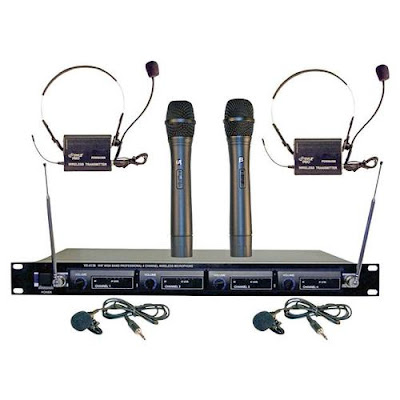
Hope you are all doing well. Today I will be blogging about part 2 on how to turn your room into a presentation room. That's right, I will be giving you my own professional recipe, and also reveal the type of system I am currently using in my classroom. If you look at the picture to the left.  This is the wireless system I am using in the classroom.  This system requires no connection to your computer.

The students are amazed by it, especially when they get to talk on it, or give presentations. Just this past week, elementary students from first to fifth grade were able to hold the wireless microphone, while I used the lavaliere microphone clipped to my tie.

The students were so excited to hear their own voice over the speakers in my room. Several students were able to ask questions, read the daily objective, and give PowerPoint presentations while using the wireless microphones. I think they really cherished and enjoyed this experience.

The professional VHF wireless microphone comes with 4 wireless microphones. I have been using this system for the past 2 years and it is a pretty good system for students to use. Last year during the end of the school year party we pulled out all four microphones plus another corded one I had, and had a great Karaoke party in my room. The kids really enjoyed the experience to hear their voice amplified through the system. These are just a few uses you can use the system with.

This is a professional VHF wireless system from Pyle that comes with two handheld microphones, two belt pack transmitters that clip on to your belt with lavaliere and headset microphones, power on/standby/off switch, four 9 volt batteries and ¼ audio cable included, RF indicators, AF level meters, individual volume controls, ¼” individual and mixed output, frequency range: VHF 160-270MHz, operation range: up to 240 ft., power supply: 110/220 V Dimensions: 16.5” x 8.2” x 1.8”
Model Number: Pyle Pro PDWM4300
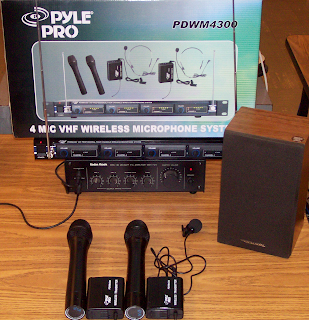

When you look at the picture on the left, you will see the VHF wireless system I am currently using with my students. I also use a corded microphone (not pictured) that you can buy separate. (I use the Memorex brand) I have the headsets put up in my room.

We get the headsets out on special occasions. I have a MPA-30 20 Watt PA amplifier 120V/12V by Radio Shack, which is connected to a little speaker that I place in the center of the room. (By the way, the amplifier, and the speaker were given to me by a close friend of mine, who found out I was using professional microphones in my room.

You see, when you are doing great things in your classroom, people tend to want to help you out!) There are several 20 watt PA amplifiers you can find online, just google them. As I was writing this post I saw some on Ebay, for as little as $10. Also you will need to get some small speakers (not computer speakers) to plug into the back of the amplifier. Once you connect all these together you are ready to use it.

By the way if you go to this site you can see the manufacturer’s manual: http://www.pyleaudio.com/manuals/PDWM4300.pdf The manual will give you even more detail about the system. At the time I was blogging, this professional VHF wireless system retails for about $267. You can check it out from the Manufacturers web site at by clicking on Here. As I said you can build this system for under $200. When I purchased my system I paid around $110.

 Unfortunately the price has gone up. If you are interested in the VHF wireless system, check out the ones below to see if these are in your budget. Ok, we will see you next week, coming up in a few weeks you will hear about the podcasting and vodcasting classes I am teaching with a colleague of mine. Talk to you later.
readmore »»  

Sunday, January 24, 2010

How to Turn any Room into a Presentation Room with Your Computer Part 1


Hello,

Today I am blogging about how to set up a microphone PA system in your classroom. You can turn any room into a presentation room by using your computer, and your computer speakers.

 I think teachers should create a Great Experience for their students, and having a microphone, and speakers in their room does that. You can have students give presentations, and they can hear their voice amplified over your speakers. You can teach your students interview skills, and presentations skills. You can also teach them how to defend proposal, and premises in front of the class.

From my experience of visiting different elementary schools, I am finding about less than 1% of the teachers use microphones in their classrooms. So this can be a great way to help your students in having an unforgettable experience that they will never forget, while teaching them presentation skills at a young age.

It is as easy as connecting a microphone to the back of your computer through your sound card. You want to make sure you have computer speakers connected to your computer, so the sound can come through them. As you can see in the picture, you connect the round metal tip to the back of your sound card. At the end of the cord, it is usually color coded to match the color of your jack input in your soundcard. If it is not, then you are looking for an imprint or picture of a microphone on the back of your sound card.

Your other options are to buy a USB Microphone and just plug in the Microphone into a USB port. Many USB Microphones come with software you have to install before you connect the microphone to the computer. Once you do this, then all you have to do is to go into your sound and audio devices in your settings on your computer to turn on the microphone. To do this you have to left click on your green start button on the bottom left side of your computer screen. There are two views you could be using on your computer. (To enlarge the pictures you need to rapidly double click the pictures with the left side of the mouse)

The first view is the classic start menu and the second view is the new start menu. Let’s go over the first one, the classic start menu. Older computers have this menu and it looks like this Click on control panel and you are looking for an icon that says Sounds and Audio Devices Once you find it, rapidly double click with the left side of the mouse and you will see a menu like this

The second view is the newest view for Windows XP, Vista, and Windows 7. Left click on the green start button on the bottom left of your screen. You are now looking for this button on the right side of the start menu. You will need to left click on the control panel button. Next, you will see this menu You will need to rapidly double click with the left side of the mouse on the Sounds, Speech and Audio Devices. This is the next menu you will see after you have opened up your Sounds and Audio Devices Options. You will be on the sounds tab button. You can place a check by the Place volume icon in the taskbar and then you want to click the button below that Advanced and you will see a menu like this You will want to uncheck the box that says Mute under the button that says Microphone, so you can hear sound coming out of your microphone. Do not worry about the other checks. You can close the Playback Control box and close the Sounds and Audio Devices Menu. You should now be able to talk with your microphone and hear the voice sounds projecting through your computer speakers.

Hope this helps if you have any other challenges while setting this up, please visit this following resource site: http://atr.k12.hi.us/tutorials/tutorials/sound/soundpt1.htm#one We will see you next week with part 2 on how to create set up a four professional wireless microphone system in your room for under $200. That's right I will be giving you all the details of where I purchased my professional wireless microphone system fron under $100. See you next week!
readmore »»  

Sunday, December 20, 2009

Tell the Whole World!

If a picture is worth a thousand words, then what is a talking picture worth? This week I am introducing a new web site that lets you turn any picture into a talking picture. That’s right, a regular picture into a talking picture. All you have to do is click on the picture to the left or click on the following link: http://www.blabberize.com/ Just like the picture says, it only takes 30 seconds. It's fast, easy and also fun to use. How would you like to use this tool to teach the students a concept or an idea from a talking picture?Your students or audience will love it. You can also put it in presentations or entertain your audience to make a point. Hope you have fun playing with it and we will see you next week.
readmore »»